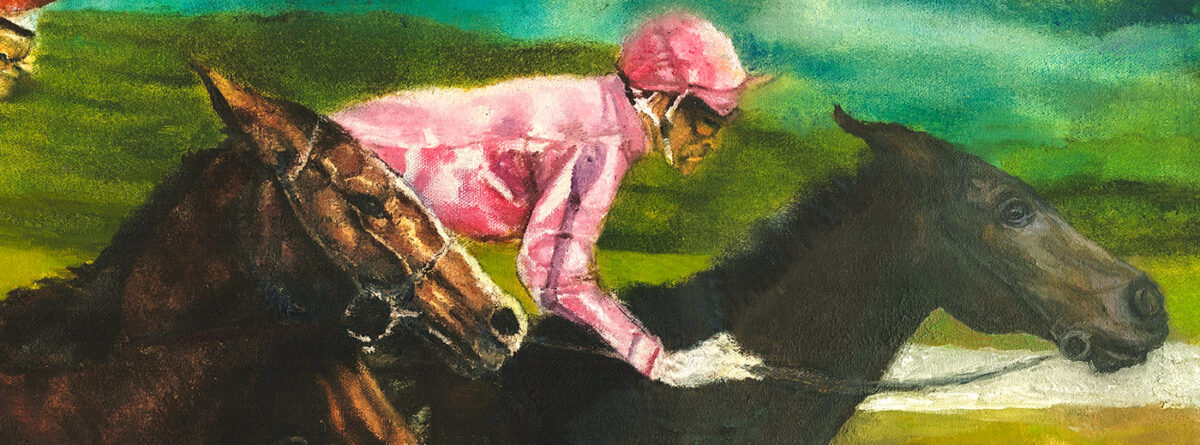
Horse Racing, I like to re-create that moment we feel when we watch them speeding, first, by placing the objects next to each other and using geometric shapes together as a plane. Then, build layers to add depth.
HORSE RACING
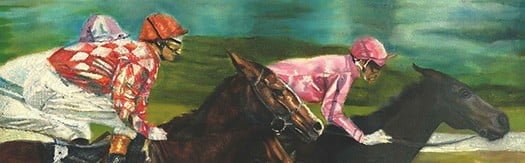
“The Front Runner” 30″ x 14″ Oil on canvas 2017
VIDEO LINK
HORSE RACING PAINTING
The first racetrack started on Long Island in 1665. Although the sport was local for some time, organized racing began after the Civil War in 1868.
Lastly, grooming care and training require long hours. Subsequently, horses are susceptible animals. They have good memories, and they can sense human emotions. Therefore, they share a special bond with their trainee. “In the cross above is an exciting, never-ending experience.” Moreover, my first painting above took me months to finish. From then on, I thought it was over. So, five years later, I did the final touch-ups.
Furthermore, as I developed these subjects, I discovered more. Explore and release creativity; there is so much to learn and add! Likewise, I live this freedom by holding a fraction of my running adrenaline. The color pigments set the tone in time. “Close-ups are attractive and directed to details.”
Indeed, my first impression of studying horses and Jockeys was Edgar Degas. Afterward, he sketched and painted the rider and horses while training. I use sketches and my photos as references to create dynamics. As a result, they allowed me to get them at their power peak. Nevertheless, something the old masters would have been pleased to use. And by the way, the term “Disc Jockey” came from about 1520, “Boy Fellow,” originally a Scottish variant of Jack.
Horse Racing, I like to re-create that moment we feel when we watch them speeding, first, by placing the objects next to each other and using geometric shapes together as a plane. Then, build layers to add depth.
HORSE RACING
“The Front Runner” 30″ x 14″ Oil on canvas 2017
VIDEO LINK
HORSE RACING PAINTING